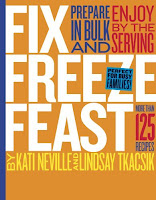
If you come home every night with the question, “What am I going to make for dinner?” than the book Fix Freeze Feast by Kati Neville and Lindsay Tkacsik might just be the book for you. In it, the authors suggest using Warehouse stores like Costco to buy large quantities, prepare several meals in advance, and store them in your freezer for the convenience of later use. If, on your list of priorities, saving time rates slightly higher than saving money than this book will show you how to do just that.
It’s really a smart concept, too. It’s just so much easier to already have dinner made when you’re rushed in the evenings after a long day. And the recipes included in the book cover everything from meatless meals and breakfasts to sauces and main dish meats. Their plan seems to be very flexible in that it suggests tailoring your prep work to the specific needs of your family. If you want to do a marathon day of cooking than it’s possible. But if you just want to store a few meals at a time you can do that too.
The book will show you how to plan your meals and create a shopping list. It also covers how to get the most from your shopping trip, how to set up your kitchen for efficient use and how to prepare your meals for the freezer with proper labels and re-heating instructions. So if you’d like to have a home cooked meal ready for your family every night, Fix Freeze Feast can help you do it.

I freeze or can most of my garden produce, but sometime around mid winter I’d really like to be able to eat a sweet, homegrown, fresh, carrot rather than one that’s been sitting in a jar in my cupboard or it’s shameful cousin the flavorless grocery store carrot. And then I come across a book like Root Cellaring: Natural Cold Storage Of Fruits & Vegetables by Mike and Nancy Bubel and know that it’s possible.
This books is a smorgasbord of information on planning for and storing your harvest. And it not only covers fruit and vegetable storage techniques but it also covers grain, nut and egg storage as well. It also dispels the myth that a root cellar has to be a huge construction project by offering alternatives like using a basement, a cubbyhole under a porch, or a recycled delivery truck body conveniently buried in the side of a hill.
Root Cellaring goes into great detail teaching it’s reader how to prepare their harvest for storage, avoid spoilage, keep pests out, and build special storage containers for certain fruits and vegetables. It addresses humidity control, ventilation, accessibility, lighting and drainage. It also has numerous building plans for traditional root cellar construction and mouth watering recipes at the end of the book.

I really dislike purchasing fresh seeds every year for my garden. Not only is it an unnecessary expense but I just never know what kind of chemicals may have come in contact with the seeds that will be growing the vegetables that will feed my family. And every year I stare at my garden and wonder just how difficult it would be to save some of my organically grown seeds to replant with next year. And that thought is about as far as I get. Well this year will be different. The book Saving Seeds by Marc Rogers has come to my rescue.
Savings Seeds: The Gardeners Guide To Growing and Storing Vegetable and Flower Seeds is a science lesson in itself. The author not only starts with the nitty gritty of what a seed is, but provides diagrams and drawings on the development of seed to plant. Building off of that, it talks about selecting the best seed “parents”, proper collection and storage, and testing your seeds for germination success.
Several chapters are devoted specifically to vegetables and their characteristics for saving seeds. It goes into great detail regarding their pollination, isolations needs, seed viability and life cycle. Photos and tips are provided to guide you to the best of your crops to harvest for seed. The information in the book is vast and could easily become overwhelming for a novice gardener like me, but by attempting the authors methods on just a few vegetables at a time I think that could be prevented. And if you’re a gardener with more experience, this book will be a great next step for having a self sufficient garden.
And flower gardeners, don’t feel left out. There’s a large section on flowering ornamentals as well as some fantastic seed sources and further reading lists at the end of book.

I’ve always been intrigued by the food preparation techniques of years gone by. We live in a time of such convenience, where it only takes a quick drive to the supermarket to find a huge variety of ready made foods, that it’s easy to miss out on the wholesomeness and tradition of making our own. So when I came across the book, The Home Creamery by Kathy Farrell-Kingsley, my visions of Caroline Ingalls churning butter in her wooden churn jumped to the forefront of my mind and I knew I wanted to give it a try.
The Home Creamery takes what could be an intimidating concept, making your own dairy products, and reveals how truly simple it is. It not only shows you how to make butter, yogurt and sour cream but also soft un-ripened cheeses like cream cheese, cottage cheese, ricotta and mozzarella. And that’s just a sample of what this book has to offer. You’ll get a full education on setting up your own personal home creamery, the simple equipment you’ll need, and the basic steps and tips to successfully produce the freshest dairy products you’ve ever tasted. They don’t even compare to store bought. And thrown in with all that is a little bit of lore and history as well as a treasure trove of recipes to use up your freshly made creams and cheeses. This is a book that will be a great addition to any cooks collection.
So if any of these books interest you, you can find out more about them by following the link in my right sidebar under "I Recommend".


 It's a study of what families are eating all over the world and it represents families on all the continents. The authors traveled to all of these people's homes, went shopping with them for one weeks worth of groceries and then took photos of the families next to their weeks supply of food.


